Abstract ABSTRACT
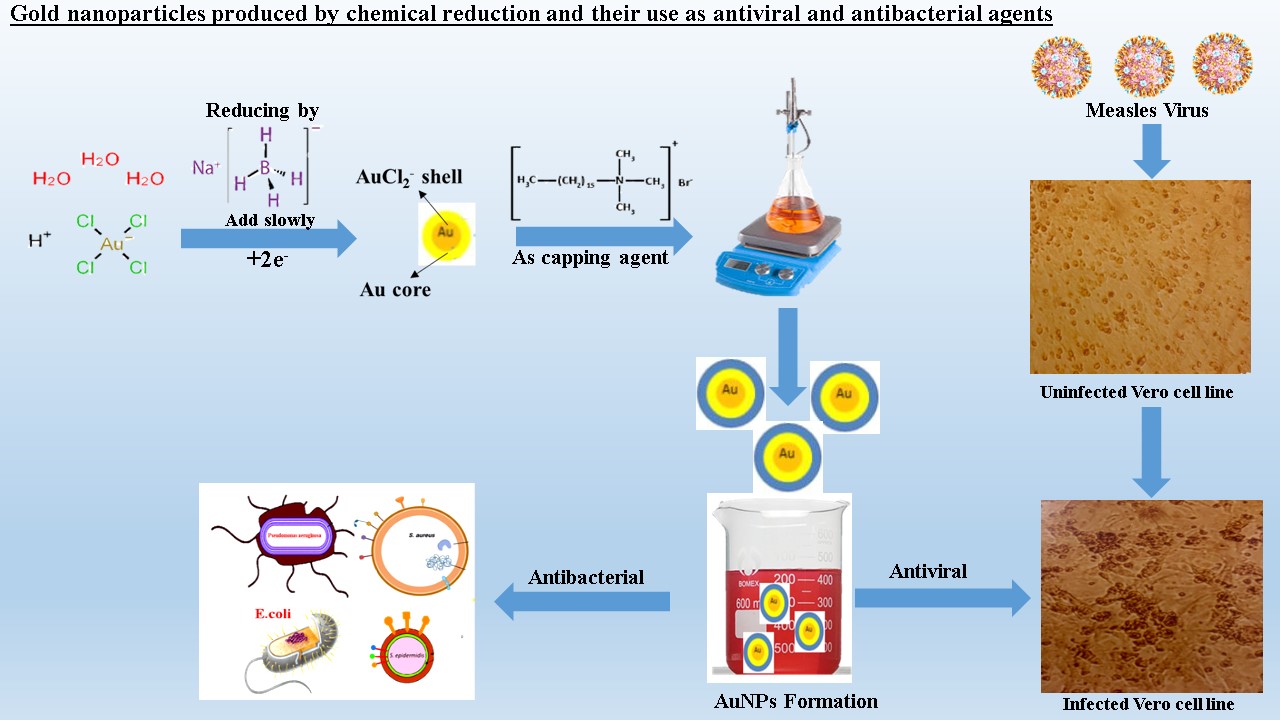
Background: The urgent need to combat contagious diseases has prompted the international community to search for new and innovative solutions. Gold nanoparticles (AuNPs) have received significant attention due to their distinctive chemical properties, which makes them the most promising future medicines
Methods: The work employed a range of methodologies to investigate the stability, size, and concentration of gold nanoparticles (Au NPs), including UV spectral analysis, zeta potential imaging, dynamics of light scattering (DLS), atomic forces (AFM), electron microscopy with transmission (TEM), and flame-absorbed atomic spectroscopy (FAAM). Measles virus (MV) was cultured in the Vero cell line and determined the TCID50 %, Knowing the ability of different concentrations of gold Nano (AuNPs) to inhibit the measles virus at different MOI When used in a preprocessing manner and estimated the antibacterial effects of (AuNPs) against selected pathogens (Staphylococcus aureus, Staphylococcus epidermidis, Pseudomonas aerogenosa, and Escherichia coli)
Results: AFM and TEM examination determined that the gold nanoparticles (Au NPs) had a spherical form with an average diameter of about 20.65 nm. In the DLS investigation, a diameter variation of 24.3 ± 0.9 nm and a polydispersity of (0.463 ± 0.05) were observed. The concentration was 625 µg/ml.
The synthesized AuNPs capably inhibited the propagation of MV in Vero cells with different MOI, especially MOI (7) with 4.6 μg/ml of gold Nano. AuNPs showed potent antibacterial activity against S. aureus and S. epidermidis at two concentrations (9.3 and 4.6 μg/ml), while the inhibitor was limited to concentration 4.6 for P. aerogenosa and E. coli.
Conclusion At low concentrations, the synthesized gold nanoparticles have been shown to effectively and safely suppress the measles virus and some multidrug-resistant bacterial isolates.