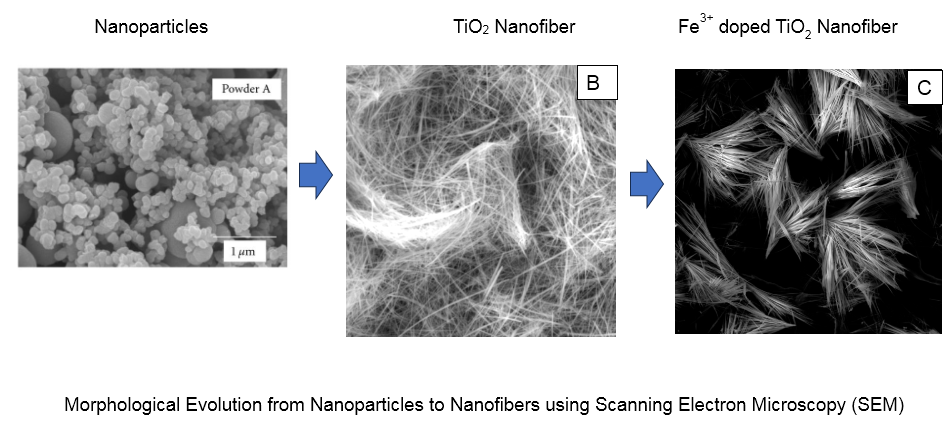
The morphology of nanostructured materials has an important role in determining their activity and functional properties, both in photocatalysis, sensors, optoelectronic devices, nanomedicine, energy storage and renewable energy applications. Various studies have shown that unique morphologies, such as nanofibers, can significantly improve the performance of materials in a variety of applications. In this context, titanium dioxide (TiO₂) doped with transition metal ions, such as Fe³⁺, has attracted attention due to its potential for improved optical and magnetic properties. This study aims to understand how the self-assembly process can produce nanofiber morphology in Fe³⁺-doped TiO₂, as well as analyze the effect of doping on changes in morphology and material properties. Through the process of hydrothermal synthesis, Fe³⁺-doped TiO₂ is developed from a nanoparticle structure into a nanofiber. The morphology and properties of the material were analyzed using Scanning Electron Microscopy (SEM). The results showed that Fe³⁺ doping affected the self-assembly process which led to the transformation of nanoparticles into nanofibers.
Misriyani,M. (2025). Self-assembly and Morphological Analysis of Fe³⁺-doped TiO₂: from Nanoparticles to Nanofibers. Chemical Review and Letters, 8(2), 280-285. doi: 10.22034/crl.2024.481027.1434
MLA
Misriyani,M. . "Self-assembly and Morphological Analysis of Fe³⁺-doped TiO₂: from Nanoparticles to Nanofibers", Chemical Review and Letters, 8, 2, 2025, 280-285. doi: 10.22034/crl.2024.481027.1434
HARVARD
Misriyani M. (2025). 'Self-assembly and Morphological Analysis of Fe³⁺-doped TiO₂: from Nanoparticles to Nanofibers', Chemical Review and Letters, 8(2), pp. 280-285. doi: 10.22034/crl.2024.481027.1434
CHICAGO
M. Misriyani, "Self-assembly and Morphological Analysis of Fe³⁺-doped TiO₂: from Nanoparticles to Nanofibers," Chemical Review and Letters, 8 2 (2025): 280-285, doi: 10.22034/crl.2024.481027.1434
VANCOUVER
Misriyani M. Self-assembly and Morphological Analysis of Fe³⁺-doped TiO₂: from Nanoparticles to Nanofibers. Chem. Rev. Lett., 2025; 8(2): 280-285. doi: 10.22034/crl.2024.481027.1434