Enhancing energy efficiency of LPG separation units through pinch-based heat integration in refinery operations

Document Type : Research Article

Authors

1 LASPI, Mohammadia Engineering School, Mohammed V University in Rabat, Ibn Sina, B.P. 765, Agdal, Rabat, 10090, Morocco.

2 SMC, Nouakchott University, B.P. 5026. Nouakchott, Mauritania.

10.22034/crl.2025.529567.1695
Abstract
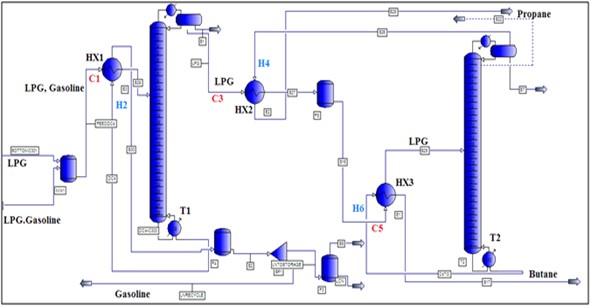
The separation of Liquefied Petroleum Gas (LPG) in oil refineries typically relies on two highly energy-intensive distillation columns: the debutanizer and the splitter. Their significant heat demand contributes directly to elevated operating costs and greenhouse gas emissions. This study aims to enhance the energy efficiency of these units through a heat-integration strategy based on Pinch Technology. Industrial operating data from an active refinery were used to simulate the existing configuration in PRO/II software employing the Peng–Robinson equation of state. The model was validated, showing satisfactory agreement between simulated and actual plant performance. A new heat-integrated configuration was then proposed by introducing three process-to-process heat exchangers to recover and reuse thermal energy within the LPG separation train. Simulation of the optimized design reveals a 23.46% reduction in overall energy consumption and a 33.17% decrease in CO₂ emissions compared with the conventional setup. These results demonstrate that systematic heat integration offers an effective pathway to improving both the energy and environmental performance of LPG distillation systems.

Graphical Abstract

Enhancing energy efficiency of LPG separation units through pinch-based heat integration in refinery operations

Keywords

Subjects


Volume 8, Issue 6 - Serial Number 6
November and December 2025
Pages 1307-1317

  • Receive Date 15 September 2025
  • Revise Date 13 December 2025
  • Accept Date 14 December 2025