Document Type : Research Article
Authors
1
Chemical and Radiation Protection Group, Ministry of Internal Affairs of the Republic of Uzbekistan, P. O. Box: 100029, Tashkent, Uzbekistan.
2
University of Public Safety of the Republic of Uzbekistan, P. O. Box: 100109, Tashkent, Uzbekistan.
3
Department of Chemistry, National University of Uzbekistan named after Mirzo Ulugbek, P. O. Box: 100174, Tashkent, Uzbekistan.
4
Department of Pharmaceuticals and Chemistry, University of Alfraganus, P. O. Box: 100190, Tashkent, Uzbekistan.
5
Department of Medical Biological Sciences, KIMYO International University in Tashkent, P. O. Box: 100121, Tashkent, Uzbekistan.
6
Department of Physics and Chemistry, Tashkent Institute of Irrigation and Agricultural Mechanization Engineers, National Research University, P. O. Box: 100000, Tashkent, Uzbekistan.
7
School of Engineering, Central Asian University, P. O. Box: 111221, Tashkent, Uzbekistan.
8
Faculty of Pharmacy, Tashkent Pharmaceutical Institute, P. O. Box: 100015, Tashkent, Uzbekistan.
9
Department of International Finance, Tashkent State University of Economics, P. O. Box: 100066, Tashkent, Uzbekistan.
10.22034/crl.2025.540565.1674
Abstract
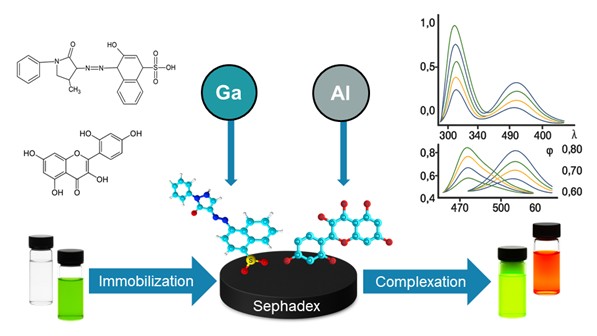
This work reports the development of novel sorption–luminescent methods for the determination of aluminum (Al³⁺) and gallium (Ga³⁺) ions using immobilized organic reagents – morin and Eriochrome Red B. The novelty of the study lies in the integration of solid-phase immobilization with luminescence spectroscopy and quantum-chemical modelling (pKa, pKa*, fluorescence quantum yield analysis, DFT/AM1), which enabled interpretation of complexation mechanisms and protolytic equilibria. Optimal immobilization conditions on polymeric carriers (pH, contact time, carrier type) were established, ensuring high reagent loading and signal stability. The developed methods achieved detection limits as low as 0.0006 µg/mL for Al³⁺ and 0.0078 µg/mL for Ga³⁺, excellent linearity of calibration plots (R² ≥ 0.999), short analysis time (≤5 minutes), and good repeatability (Sr = 0.10 and 0.08). Measurements were performed at pH 4.0–6.0 (λ = 540 nm) for Al³⁺ and pH 3.0–5.0 (λ = 651 nm) for Ga³⁺. Application to natural and industrial wastewater samples demonstrated analytical reliability and practical applicability for routine environmental monitoring. The results highlight the environmental significance of monitoring toxic Al³⁺/Ga³⁺ species and show that the developed reagent–carrier systems can serve as sensitive layers for optical sensor devices, providing a robust and versatile platform for environmental sensing.
Graphical Abstract
Keywords
Subjects