DFT investigation of aflatoxin B1 adsorption on vacancy-defective graphene: electronic properties and sensing potential

Document Type : Research Article

Authors

1 Department of Chemistry, Payame Noor University (PNU), Tehran, Iran

2 Faculty of Pedagogy and Social-Humanitarian Sciences, Interfaculty Department of Foreign Languages, Termez University of Economics and Service, P. O. Box: 190111, Termez, Uzbekistan.

Abstract
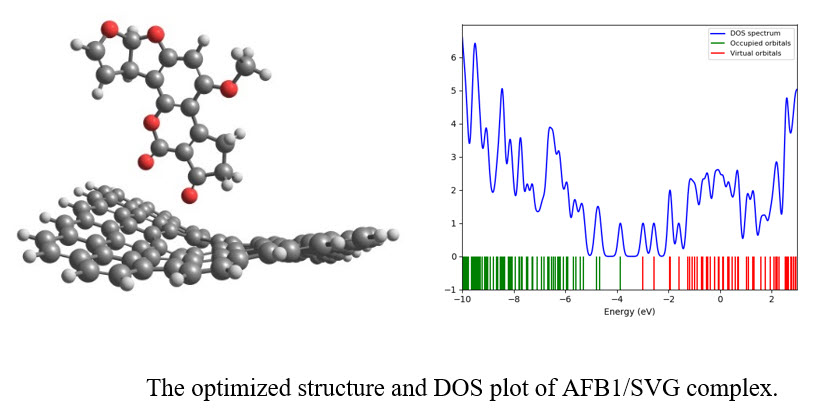
Aflatoxins (AFs) are highly toxic compounds that pose substantial health risks, eliciting both Aflatoxin B1 (AFB1) is a highly toxic mycotoxin with severe health implications, necessitating rapid and sensitive detection methods. This study aims to investigate the potential of defect-engineered graphene nanosheets as electronic sensors for AFB1 detection. Using density functional theory (DFT), the adsorption behavior of AFB1 on perfect graphene (PG), single-vacancy graphene (SVG), and double-vacancy graphene (DVG) was systematically analyzed. The results reveal weak physisorption on PG, with minimal influence on electronic properties, whereas vacancy defects introduce reactive sites that markedly enhance adsorption strength and sensor response. In SVG, adsorption lowers the energy gap from 0.81 eV to 0.54 eV and decreases the work function from 3.57 eV to 3.53 eV, leading to increased conductivity and field emission current. Atoms in Molecules (AIM) analysis indicates that interactions are predominantly van der Waals in nature, confirming a physisorption-dominated mechanism. These findings demonstrate that single-vacancy defective graphene offers superior sensitivity and electronic modulation, underscoring its promise as an efficient nanosensor for AFB1 detection and highlighting the critical role of defect engineering in graphene-based sensor design.

Graphical Abstract

DFT investigation of aflatoxin B1 adsorption on vacancy-defective graphene: electronic properties and sensing potential

Keywords

Subjects


Volume 8, Issue 6 - Serial Number 6
November and December 2025
Pages 1258-1268

Supplementary File

  • Receive Date 31 August 2025
  • Revise Date 12 November 2025
  • Accept Date 13 November 2025