Synthesis of silver nanoparticles: A comprehensive review

Document Type : Review Article

Authors

1 Institute of Polymer Chemistry and Physics, Academy of Sciences Republic of Uzbekistan, Tashkent, Uzbekistan.

2 Yangiyer Branch of The Tashkent Chemical Technology Institute, Tashkent, Uzbekistan.

3 Yangiyer Branch of the Tashkent Chemical Technology Institute, Tashkent, Uzbekistan.

4 University of Business and Science, Tashkent, Uzbekistan.

5 Gulistan State Pedagogical Institute, Tashkent, Uzbekistan.

6 Tashkent University of Architecture and Construction Tashkent, Uzbekistan

7 Trivandrum Engineering Science & Technology Research Park, Mahatma Gandhi University, Kottayam, Kerala, India.

8 Institute for the Study of Nanostructured Materials, National Research Council, Montelibretti (RM), Italy.

Abstract
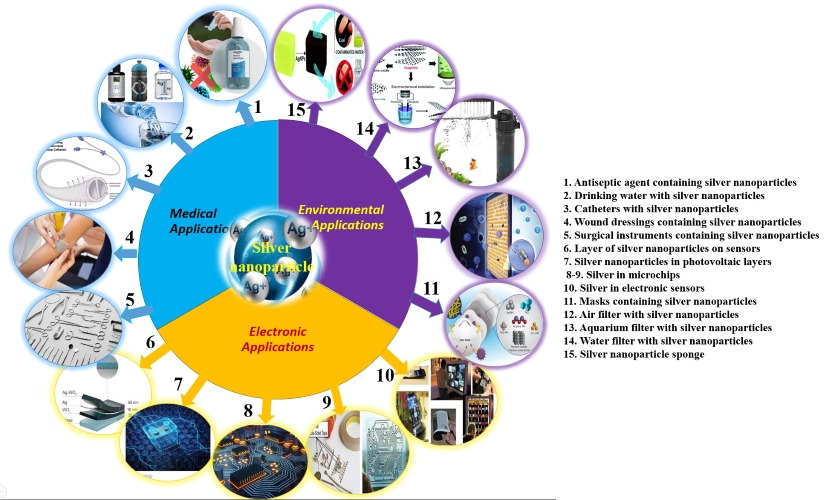
This review article examines the synthesis of silver nanoparticles (AgNPs), highlighting modern methods in their production. The discussion encompasses chemical, physical, and biological synthesis techniques, detailing the advantages and limitations of each approach. Chemical synthesis often involves reducing agents like sodium borohydride and ascorbic acid, producing nanoparticles with controlled size and shape but posing environmental risks. Physical methods, such as laser ablation and ball milling, offer high-purity nanoparticles but require significant energy and specialized equipment. Biological synthesis, using plant extracts, bacteria, and fungi, provides a green alternative, producing biocompatible nanoparticles though with variable results. Recent advancements emphasize green synthesis methods, particularly the use of gallic acid, a natural antioxidant, which offers a consistent, eco-friendly, and efficient approach to nanoparticle production. After comparing the advantages and disadvantages using the latest literature, the study finds that the biological synthesis method, especially with gallic acid, is the most preferable due to its biocompatibility and ability to produce stable, uniform nanoparticles. The review explores the potential applications of AgNPs in medicine, electronics, and environmental science, concluding that gallic acid-mediated synthesis is particularly suited for biomedical applications. This comprehensive review aims to provide a detailed understanding of AgNP synthesis methods, contributing to the advancement of this crucial field in nanotechnology

Graphical Abstract

Synthesis of silver nanoparticles: A comprehensive review

Keywords

Subjects


Volume 8, Issue 6 - Serial Number 6
November and December 2025
Pages 1155-1168

  • Receive Date 01 April 2025
  • Revise Date 01 May 2025
  • Accept Date 27 August 2025