Comprehensive DFTB Investigation of Epoxy- and Hydroxyl-Modified Graphene: Unveiling Electronic Structure and Potassium Ion Interaction

Document Type : Research Article

Authors

1 Chemistry Departmenet, Faculty of Mathematics and Natural Sciences, Universitas Sebelas Maret, Surakarta, Central Java, Indonesia

2 Chemistry Department, Faculty of Mathematics and Natural Sciences, Universitas Sebelas Maret, Surakarta, Indonesia

3 Chemistry Department, Faculty of Mathematics and Natural Sciences, Universitas Gadjah mada, Yogyakarta, Indonesia

Abstract
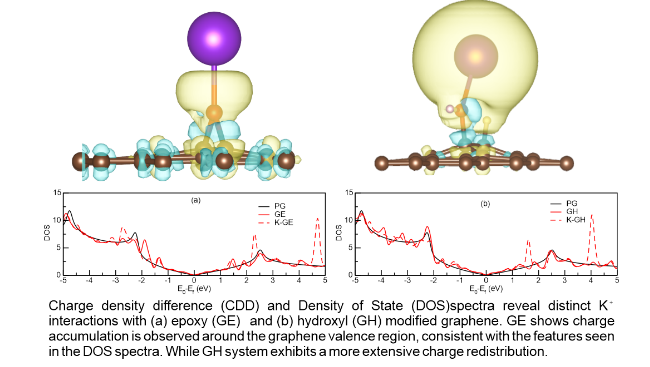
Distinguishing the electronic differences between epoxy- and hydroxyl-functionalized graphene is essential, as each group alters the charge distribution and electronic density. These changes affect K⁺ ion interactions, including adsorption strength and selectivity. The Density Functional Tight Binding (DFTB) method effectively captures these differences and reveals their distinct interaction mechanisms. Both the epoxy and hydroxyl groups significantly modify the electronic properties of graphene, notably increasing the electronic density near the Fermi level. A band gap of 0.72 eV was observed in hydroxyl-functionalized graphene (GH), likely resulting from changes in the delocalized orbitals between the HOMO and LUMO. In contrast, epoxy-functionalized graphene (GE) exhibited no significant band gap opening or Fermi level shift, indicating a more conductive structure. The charge density differences further reveal distinct charge accumulation and distribution patterns on the GE and GH surfaces, consistent with their respective density of states (DOS) spectra. This variation in electronic structure directly influences their interaction with K⁺ ions, with measured interaction energies of –1.702 eV for GE and –1.423 eV for GH, suggesting that GE provides a more favorable environment for K⁺ ion support.

Graphical Abstract

Comprehensive DFTB Investigation of Epoxy- and Hydroxyl-Modified Graphene: Unveiling Electronic Structure and Potassium Ion Interaction

Keywords

Subjects


Volume 8, Issue 4 - Serial Number 4
July and August 2025
Pages 700-708

  • Receive Date 03 June 2025
  • Revise Date 20 July 2025
  • Accept Date 25 July 2025