Synthesis and investigation of the properties of the nickel, cobalt and phosphorus catalysts

Document Type : Research Article

Authors

1 Department of chemistry teaching methodology, Jizzakh State Pedagogical University, Sharof Rashidov street 4, Jizzakh region, Jizzakh city 130100, Uzbekistan

2 Azerbaijan State Pedagogical University AZ 1000, U. Hajibekova St.68, Baku, Azerbaijan

3 Doctor of Chemical sciences, professor, Head of the department of Physical chemistry of the National University of Uzbekistan Named after MirzoUlughbek, Uzbekistan

Abstract
Nowadays, scientists around the world are paying more attention to renewable hydrogen fuels. There is a growing need for precious metal catalysts to calculate the cost of obtaining renewable energy, an efficient method of producing H2 by electrolysis of water, as well as to facilitate the decomposition of water into its elemental parts. Today, due to the increase in the problem of the shortage of energy resources and the growing of CO2 emissions into the atmosphere, attention is being paid to hydrogen energy. However, the production of H2 requires low-cost, efficient catalysts that facilitate hydrogen/oxygen separation reactions in the water splitting. For this purpose, intermediate metal phosphides (Fe, Co, Ni, Cu, Mo, W) were used as effective electrocatalysts for water decomposition. The catalytic activity of intermediate metal phosphides to form hydrogen is largely dependent on the phosphorus content, but the P atoms play an important role in increasing efficiency. The production of hydrogen by electrolysis of water on the basis of bifunctional catalysts has good prospects for use in the energy industry. In the article, the one-step hydrothermal synthesis method and physico-chemical (electronic structure and conductivity, structure morphology) of double metal phosphide with NixCuyPz composition were studied.

Graphical Abstract

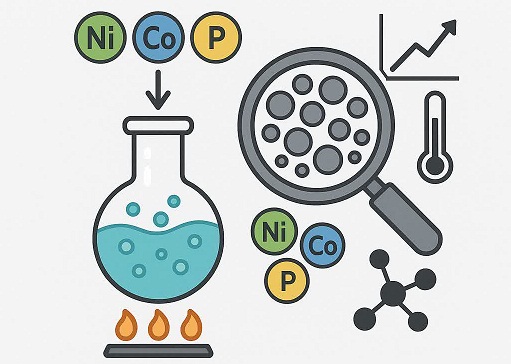
Synthesis and investigation of the properties of the nickel, cobalt and phosphorus catalysts

Keywords

Subjects


Volume 8, Issue 3 - Serial Number 3
Spring 2025
Pages 493-497

  • Receive Date 20 October 2024
  • Revise Date 09 June 2025
  • Accept Date 01 June 2025