Photocatalytic activity of hydrothermally prepared nanomaterial ZnMn2O4 and ZnO thin films on degradation of Congo red dye: A comparison study

Document Type : Research Article

Authors

1 Department of Chemistry, Yasouj UNiversity, Yasouj 7591874831 Iran

2 Department of chemistry, University of Isfahan, Isfahan,81746-73441 Iran

Abstract
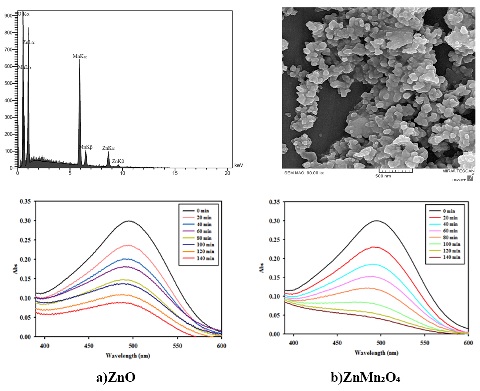
This study focuses on innovative water treatment solutions by investigating the photocatalytic degradation of Congo red dye using two advanced nanomaterials, thin films of zinc oxide (ZnO) and zinc manganese oxide (ZnMn2O4). Both nanomaterials were derived from nitrate precursors at calcination temperatures of 500, 650 and 800 ˚C. Detailed synthesis protocols were meticulously designed to enhance the structural and morphological properties of the photocatalysts, which aims to maximize their photocatalytic efficiency under UV light irradiation. The characterization was carried out using X-ray diffraction (XRD), energy-dispersive X-ray spectroscopy (EDX), fourier-transform infrared spectroscopy (FT/IR), UV-Visible spectroscopy, diffuse reflectance spectra (DRS) and field emission scanning electron microscopy (FE/SEM). The thin films were prepared using the Doctor Blade technique. The particle size of the nanomaterials used in thin-film fabrication was calculated using the Scherrer equation, yielding values between 22 and 32 nm. Optical studies revealed that ZnMn2O₄ possesses a narrower band gap, ranging from 2.47 to 4.06 eV, compared to ZnO’s band gap of 3.36 eV. This narrower band gap enhances light absorption and improves charge separation both key factors for effective photocatalysis. Comparative photocatalytic experiments revealed that ZnMn2O4 exhibits superior performance over ZnO in degrading Congo red dye, achieving higher degradation efficiency (85.3%) and faster reaction kinetics (0.0138 min-1), compared to ZnO’s respective values of 70% and 0.0081 min-1. The superior performance of ZnMn2O4 is attributed to its optimized electronic structure and increased surface area, which results in a smaller particle sizes and more porous morphology. These findings highlight the potential of ZnMn2O4 nanocomposites as promising candidates for sustainable and efficient water treatment applications.

Graphical Abstract

Photocatalytic activity of hydrothermally prepared nanomaterial ZnMn2O4 and ZnO thin films on degradation of Congo red dye: A comparison study

Keywords

Subjects


Volume 8, Issue 4 - Serial Number 4
July and August 2025
Pages 797-812

  • Receive Date 09 April 2025
  • Revise Date 17 May 2025
  • Accept Date 20 May 2025