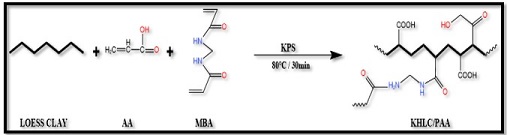
Loess is a naturally occurring mineral particle that is widely dispersed around the planet. It is also affordable, non-toxic, and readily accessible. A loess clay-based co-polymer, KHLC/PAA, was produced to support the functional monomer acrylic acid in an in situ polymerization process using N-N methylene bisacrylamide as a cross-linking agent. It was characterized by Scanning Electron Microscopy, Fourier Transformation Infrared spectroscopy, X-ray diffractometry, X-ray fluorescence spectroscopy, and thermal gravimetric analysis, followed by the examination of its adsorption capability for removing lead ions (Pb2+) from aqueous solution at room temperature in 60 minutes, which appeared to be 159.1 mg/g. The thermodynamic data showed that the adsorption process was practicable, spontaneous, and endothermic, and the experimental results suited the pseudo-second-order kinetic model and the Langmuir adsorption isotherm well. Consequently, KHLC/PAA is a potentially beneficial material for wastewater treatment as it is an inexpensive, environment-friendly adsorbent.
Bano,T. (2025). Preparation and Application of Loess-based Adsorbent for the Removal of Lead ions from Aqueous Solution. Chemical Review and Letters, 8(1), 84-100. doi: 10.22034/crl.2024.487321.1468
MLA
Bano,T. . "Preparation and Application of Loess-based Adsorbent for the Removal of Lead ions from Aqueous Solution", Chemical Review and Letters, 8, 1, 2025, 84-100. doi: 10.22034/crl.2024.487321.1468
HARVARD
Bano T. (2025). 'Preparation and Application of Loess-based Adsorbent for the Removal of Lead ions from Aqueous Solution', Chemical Review and Letters, 8(1), pp. 84-100. doi: 10.22034/crl.2024.487321.1468
CHICAGO
T. Bano, "Preparation and Application of Loess-based Adsorbent for the Removal of Lead ions from Aqueous Solution," Chemical Review and Letters, 8 1 (2025): 84-100, doi: 10.22034/crl.2024.487321.1468
VANCOUVER
Bano T. Preparation and Application of Loess-based Adsorbent for the Removal of Lead ions from Aqueous Solution. Chem. Rev. Lett., 2025; 8(1): 84-100. doi: 10.22034/crl.2024.487321.1468