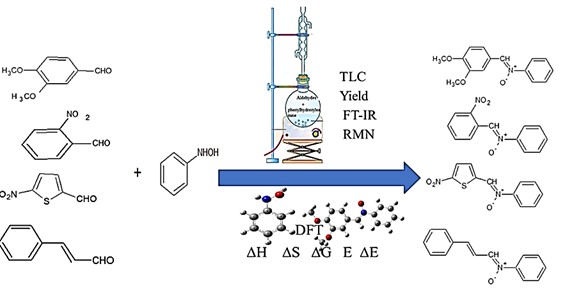
Synthesis and characterization of nitrones from aromatic aldehydes: Influence of substitution patterns, experimental yield and DFT-based reactivity insights

Document Type : Research Article

Authors

1 Higher Normal School, Laboratory of Research on Bio-Active Products and Valorization of Biomass, Old-Kouba, Algiers 16050, Algeria

2 Laboratory of Biomaterials and Transport Phenomena (LBMPT), New Urban Pole, Medea University, Medea 26000, Algeria

3 Laboratoire de Thermodynamique et Modelisation Moleculaire Faculte de Chimie USTHB BP 32 EI-Alia 16111 Bab-Ezzouar , Alger (Algeria)

4 University of Rennes, National High School of Chemistry of Rennes, CNRS, ISCR—UMR6226, F-35000 Rennes, France

5 Laboratoire de Gestion et Valorisation des Ressources Naturelles et Assurance Qualité. Faculté SNVST, Université de Bouira, 100000 Bouira, Algeria.

Abstract
This study investigates the influence of electronic and structural factors on the synthesis and stability of nitrones derived from various aromatic aldehydes. Experimentally, four nitrones were synthesized with varying yields, with nitrones III and IV derived from 5-nitro-2-thiophenecarboxaldehyde and cinnamaldehyde exhibited the highest yields of 75% and 78%, respectively. Their structures and purity were confirmed through IR and 1H-NMR spectroscopy, validating the successful synthesis. To complement the experimental work, Density Functional Theory (DFT) calculations were performed to provide detailed insights into the electronic properties and thermodynamic stability of the nitrones. These calculations included parameters such as enthalpy (ΔH), entropy (ΔS), Gibbs free energy (ΔG), the HOMO-LUMO energy gap, electrophilicity, and electron acceptance (A). Notably, nitrone III demonstrated the greatest thermodynamic stability with the lowest Gibbs free energy and a larger HOMO-LUMO energy gap, suggesting lower chemical reactivity. This computational finding is consistent with the high yield observed experimentally, indicating a strong correlation between stability and reaction efficiency. Additionally, the analysis highlighted the significant roles of electronic effects. These included the inductive and mesomeric influences of substituents on the aldehyde moieties, which modulate nitrone formation and stability. Integration of experimental and theoretical approaches enabled a deeper understanding of the structure–reactivity relationship in nitrone chemistry, offering predictive insights that could to guide the design and optimization of future nitrone syntheses.

Graphical Abstract

Synthesis and characterization of nitrones from aromatic aldehydes: Influence of substitution patterns, experimental yield and DFT-based reactivity insights

Keywords

Subjects


Volume 8, Issue 5 - Serial Number 5
September and October 2025
Pages 1080-1092

  • Receive Date 23 July 2025
  • Revise Date 06 August 2025
  • Accept Date 17 August 2025