New azo-acridine derivatives as inhibitors of AGS cell line: Synthesis, coordination chemistry, cytotoxicity, and molecular modeling studies

Document Type : Research Article

Authors

1 department of chemistry college of science university of alqadisiyah

2 Department of chemistry college of science university of AL-Qadisiyah

3 Department of chemistry college of science university of AL-Muthanna

4 Department of Chemistry, College of Education, University of Al-Qadisiyah

Abstract
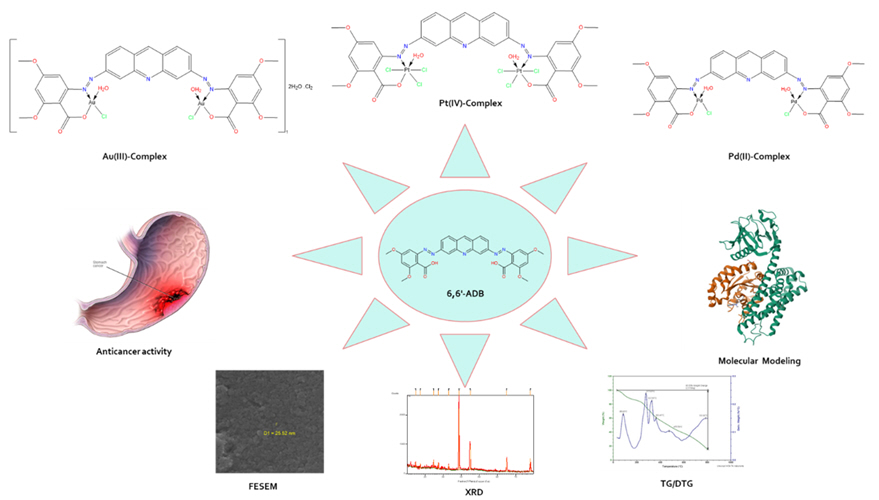
Acridines are notable heterocyclic compounds characterized by three fused six-membered rings, contributing to a planar aromatic structure. This study focuses on synthesizing the ligand 6,6'-((1E,1'E)-acridine-3,6-diylbis(diazene-2,1-diyl))bis(2,4-dimethoxybenzoic acid) through key steps involving diazonium salt formation. The synthesis begins with dissolving 3,6-diamino acridine in hydrochloric acid and water, cooled to stabilize the diazonium salt. Sodium nitrite is added for diazotization, followed by 2,4-dimethoxybenzoic acid in an alkaline medium to yield the ligand, which is then purified. Metal complexes were formed by dissolving the ligand in ethanol and adding metal chloride salts such as PdCl₂, H₂PtCl6.6H2O, and HAuCl4⋅4H2O under controlled conditions suitable for various applications. They confirmed by thermal analysis, 1H and 13C-NMR, UV-Vis, FT-IR, mass, elemental analysis, atomic absorption, and molar conductance. X-ray diffraction and FESEM techniques were employed to analyze the crystallographic structure and surface morphology of the compounds, revealing significant differences among them. Molecular docking studies indicated that the Au(III) complex exhibits strong binding affinity with the RhoA protein, a potential target in gastric cancer therapy. The MTT assay was utilized to evaluate the cytotoxicity of ligand and Au(III)-Complex against human adenocarcinoma of the stomach (AGS) cells and normal line cells (Hs 738.St/Int), highlighting their potential effectiveness in cancer treatment.

Graphical Abstract

New azo-acridine derivatives as inhibitors of AGS cell line: Synthesis, coordination chemistry, cytotoxicity, and molecular modeling studies

Keywords

Subjects


Volume 8, Issue 5 - Serial Number 5
September and October 2025
Pages 1018-1035

  • Receive Date 17 December 2024
  • Revise Date 31 December 2024
  • Accept Date 01 January 2025