Waste-derived activated carbons from phenol-formaldehyde and polystyrene: The role of PAN and alkali treatment

Document Type : Research Article

Authors

1 Institute of General and Inorganic Chemistry, Academy of Sciences of Republic of Uzbekistan

2 Institute of General and Inorganic Chemistry, Academy of Sciences of Republic of Uzbekistan, Uzbekistan, Tashkent

3 Namangan Institute of Engineering and Technology, Kosonsoy Street, 7, Namangan, 160115, Uzbekistan

4 Karakalpak State University, Karakalpakstan, Nukus

5 Kokand State University, 150700, Fergana region, Kokand, Street Turon, 23, Uzbekistan

Abstract
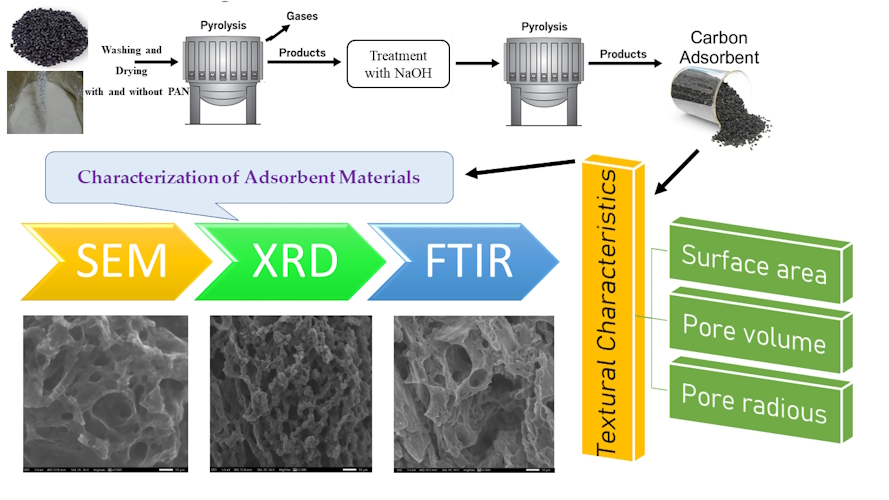
This study investigates the conversion of phenol-formaldehyde resin (PFR) and polystyrene (PS) waste into activated carbon materials with controlled porous structures. Each polymer was modified with 0–10 wt.% polyacrylonitrile (PAN), followed by carbonization at 700–800 °C in combination with chemical activation using sodium hydroxide (NaOH) at a carbon-to-NaOH ratio of 1:0.4–1:1.5. Thermogravimetric analysis revealed that PAN increases the total mass loss: for PS, from 42% to 51% at 1000 °C, and for PFR, from 36.7% to approximately 39%. X-ray diffraction analysis indicated the formation of short-range graphitic domains: in PFR-derived carbon at 800 °C, the (002) peak narrows and a weak (100) reflection appears, whereas ordering in PS-derived carbon was observed only upon PAN addition. Optimal activation with NaOH at a ratio of 1:0.8 produced an ultramicroporous structure, with specific surface areas reaching 873 m²/g for PFR-based carbon and 750 m²/g for PS-based carbon, micropore volumes of 0.9–1.0 cm³/g, and average pore radii of 3.5–3.8 Å. Electron microscopy confirmed uniform microporosity in PFR-derived matrices and a hierarchical, “cellular” morphology in PS-derived matrices. The combination of 10% PAN and NaOH activation at 800 °C yielded the most favorable textural properties, demonstrating that separate processing of PFR and PS waste with PAN modification and alkaline activation is an effective strategy for producing highly porous carbon sorbents at moderate temperatures.

Graphical Abstract

Waste-derived activated carbons from phenol-formaldehyde and polystyrene: The role of PAN and alkali treatment

Keywords

Subjects


Volume 8, Issue 5 - Serial Number 5
September and October 2025
Pages 981-1002

  • Receive Date 08 July 2025
  • Revise Date 19 September 2025
  • Accept Date 22 September 2025