Impact of alkalized nano-cellulose from Ccalotropis gigantea on biocomposite foam for fish freshness monitoring

Document Type : Research Article

Authors

1 Chemical Engineering Department, Universitas Syiah Kuala, Banda Aceh, Indonesia

2 Department of Fisheries Product Technology, Faculty of Fisheries, Universitas Abulyatama, Aceh Besar 23372, Indonesia

3 Department of Chemical Engineering, Universitas Syiah Kuala, Banda Aceh 2311, Indonesia

4 Faculty of Integrated Technologies, Universiti Brunei Darussalam, Jalan Tungku Link, Bandar Seri Begawan BE1410, Brunei

Abstract
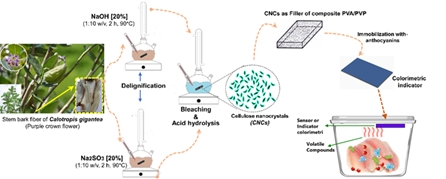
The growing demand for environmentally friendly smart packaging has driven the development of novel biopolymer-based materials that serve as food quality indicators. This study aims to evaluate the effect of different alkali agents in the production of cellulose nanocrystals (CNCs) derived from the bark of Calotropis gigantea, which are utilized as fillers in colorimetric biocomposite foams (BCFs) for non-destructive fish freshness monitoring. Two alkali agents, NaOH and 20% Na₂SO₃, were applied during the delignification stage prior to hydrolysis with sulfuric acid (40% H₂SO₄). The resulting CNCs were thoroughly characterized using spectroscopic, morphological, and thermal techniques. Morphological and structural analyses revealed that CNCs treated with NaOH exhibited the highest crystallinity index (89.54%) and featured shiny, needle-like crystals with a more uniform size distribution. In contrast, CNCs produced using Na₂SO₃ showed a lower crystallinity index (51.11%) with agglomerated morphology and uneven particle size distribution. The BCF formulated with CNCs-NaOH (0.25 g) exhibited a porous structure with a high specific surface area (10.64 m²/g), which supported the immobilization of anthocyanin-based pH indicators extracted from Clitoria ternatea. Application testing during the storage of Oreochromis niloticus at 5 °C over 30 days showed a significant color change in the indicator, corresponding to a pH increase from 5.2 to 6.3 and a rise in TVB-N values from 2.83 mg/100 g to 32.86 mg/100 g. The CNCs-NaOH-based BCF demonstrated excellent responsiveness to environmental pH changes associated with fish spoilage. This study represents the first investigation of C. gigantea as a source of CNCs through varied alkali treatment approaches for use in foam-based colorimetric indicators. The findings suggest that CNCs-NaOH derived from C. gigantea show strong potential as superior fillers in responsive and sensitive porous smart packaging for real-time detection of fish freshness deterioration

Graphical Abstract

Impact of alkalized nano-cellulose from Ccalotropis gigantea on biocomposite foam for fish freshness monitoring

Keywords

Subjects


Volume 8, Issue 5 - Serial Number 5
September and October 2025
Pages 903-917

  • Receive Date 05 June 2025
  • Revise Date 10 August 2025
  • Accept Date 24 August 2025