Investigation of hot corrosion behavior of NiCoCrAlY coatings in molten Na2SO4 - V2O5 at 900°C

Document Type : Research Article

Author

Ph.D. Candidate in Materials Science and Metallurgical Engineering, Department of Materials Engineering, Faculty of Mechanical Engineering, University of Tabriz, Tabriz, Iran.

Abstract
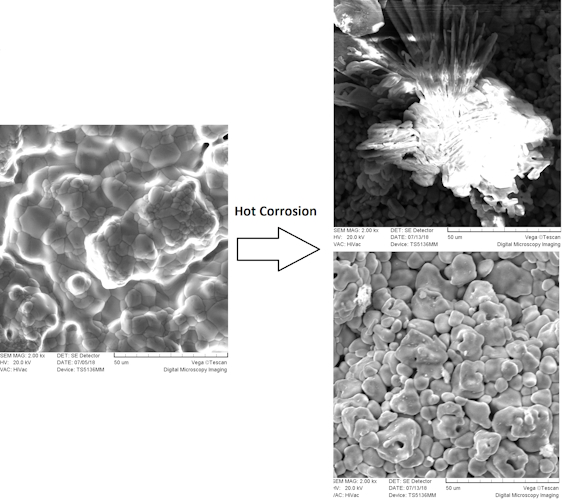
This study investigates the hot corrosion resistance of NiCoCrAlY coatings deposited on Inconel 718LC superalloy in a molten Na2SO4-50%V2O5 environment at 900°C. The coatings were fabricated via electrodeposition using varying current densities (20 and 30 mA/cm2) and NiCrAlY powder concentrations (10, 20, and 30 g/l). Results revealed that coatings with 20 g/l powder concentration and a current density of 20 mA/cm² exhibited optimal performance, demonstrating superior corrosion resistance due to the formation of protective Al2O3 and Cr2O3 scales, as well as spinel phases such as NiCr2O4. In contrast, samples with lower powder concentrations (10 g/l) suffered complete degradation owing to insufficient aluminum content. The corrosion mechanism involved the decomposition of molten salts into aggressive compounds (e.g., NaVO3 and NaAlO2), which deteriorated the protective layers. Additionally, the formation of metallic sulfides (e.g., NiS and CrS) and acid-base reactions accelerated corrosion. SEM and XRD analyses confirmed that the optimized coatings possessed a uniform microstructure and stable protective phases. This research highlights that controlling deposition parameters and coating composition can significantly enhance the service life of Superalloys in high-temperature corrosive environments.

Graphical Abstract

Investigation of hot corrosion behavior of NiCoCrAlY coatings in molten Na2SO4 - V2O5 at 900°C

Keywords

Subjects


Volume 8, Issue 5 - Serial Number 5
September and October 2025
Pages 856-866

  • Receive Date 09 June 2025
  • Revise Date 04 August 2025
  • Accept Date 13 August 2025