Pt-embedded pyrrolic and pyridinic N-doped graphene quantum dots as a viable Aflatoxin B1 sensor: insights from DFT calculations

Document Type : Research Article

Authors

1 Department of Chemical Engineering, Faculty of Engineering, Ardakan University

2 Department of Chemistry, Yazd University

3 Department of Chemistry, Payame Noor University

Abstract
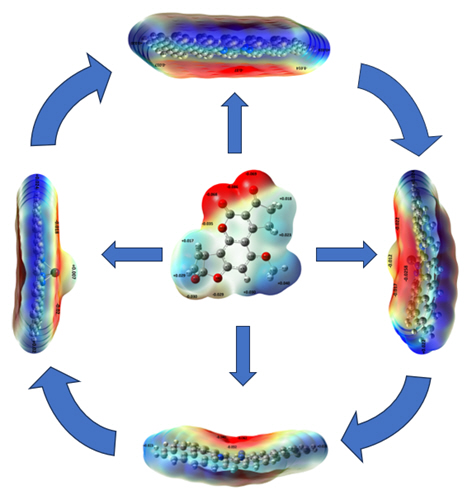
Aflatoxin B1 is a well-established carcinogen, and even low concentrations pose significant health risks by increasing the likelihood of cancer development. Therefore, various sensors have been tested to identify the most effective adsorbents for its detection. In this study, pristine and Pt-embedded nitrogen-doped graphene quantum dot sensors were modeled to investigate their interactions with Aflatoxin B1 (AFB1). Two types of nitrogen doped graphene (pyrrolic and pyridinic ones) were examined to evaluate their potential as AFB1 sensors. Multiple configurations of AFB1 were considered for each sensor to calculate binding energies and changes in the HOMO-LUMO gap. Results indicate that without a Pt single atom, the average band gap change due to AFB1 adsorption on pristine pyrrolic N-doped graphene is only 3%, which is insufficient for effective sensing. The average binding energy between AFB1 and pyrrolic N-doped graphene is approximately −1.1 eV, indicating moderate interaction. In contrast, pyridinic N-doped graphene shows an average band gap change of less than 2% and a binding energy of about −0.5 eV. Introducing a Pt single atom significantly enhances performance: the average band gap changes increase by approximately 16% for pyrrolic and over 800% for pyridinic N-doped graphene. Correspondingly, their averaged binding energies with AFB1 increase to −1.5 eV and −2.7 eV, respectively. These findings suggest that Pt-embedded pyridinic N-doped graphene is a promising candidate for disposable AFB1 sensors. Additionally, various physicochemical parameters—including ionization potential, hardness, electrical conductivity, recovery time, chemical reactivity, and electrophilicity—were analyzed. The nature of interactions between AFB1 and the two Pt-embedded N-doped graphene sensors was further examined using quantum theory of atoms in molecules (QTAIM), while stabilities arising from intermolecular charge transfers were investigated via natural bond orbital (NBO) analysis. All noncovalent interactions were analyzed and visualized using noncovalent interaction (NCI) and reduced density gradient (RDG) methods.

Graphical Abstract

Pt-embedded pyrrolic and pyridinic N-doped graphene quantum dots as a viable Aflatoxin B1 sensor: insights from DFT calculations

Keywords

Subjects


Volume 8, Issue 5 - Serial Number 5
September and October 2025
Pages 1003-1017

  • Receive Date 25 May 2025
  • Revise Date 11 June 2025
  • Accept Date 03 July 2025